
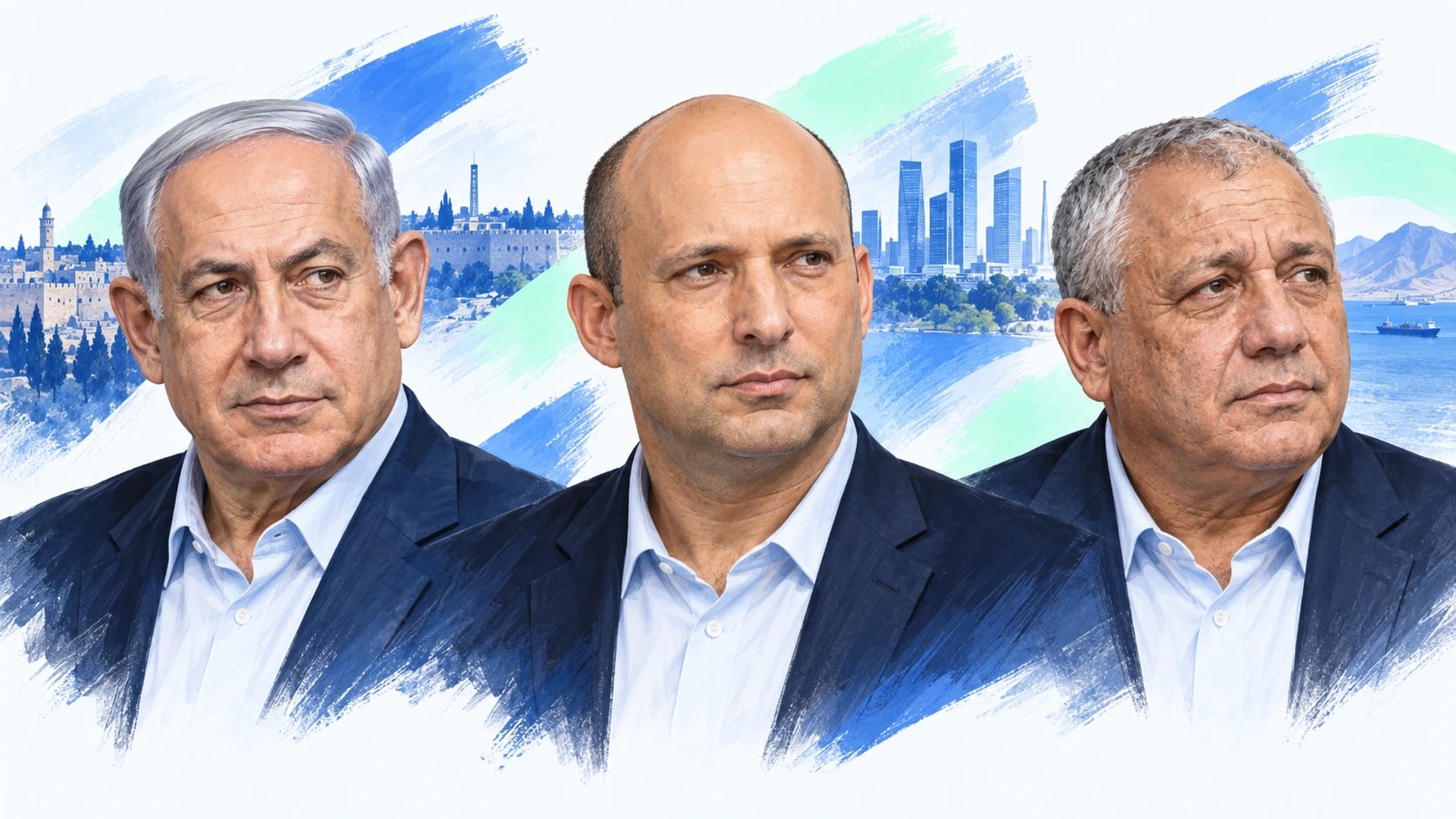
One co-founded a security company acquired in a deal worth about $145 million. Another moved from leading the military to chairing an energy-storage company. The third worked at an American consulting firm where Mitt Romney also worked. Behind Naftali Bennett, Gadi Eisenkot and Benjamin Netanyahu are different routes to the same test: turning experience, connections and a capable team into economic progress. The career details below are documented; their implications for a future government are analysis, not predictions.
Israel’s election is scheduled for 27 October 2026. Its consequences could reach a foreign fund’s investment decision, an exporter’s delivery schedule, a small business’s financing costs and an Emirati partner’s willingness to expand. For business readers, the question is whether political power can produce security, stability and an executable plan. Official election notice.
Israelis vote for parliamentary lists, not directly for a prime minister. Winning the most seats, leading a personal-suitability poll and assembling a government are different achievements. Coalition partners, ministerial powers and the ability to pass a budget matter alongside the leader’s name.
Netanyahu: before the prime minister’s office, there was Boston
Long before his speeches to Congress, Netanyahu worked at Boston Consulting Group. Mitt Romney, later the Republican presidential nominee, also worked there during that period. In a public interview in 2018, Netanyahu described the job’s influence on his belief in competition and private enterprise. Two people from the same consultancy eventually reached the top ranks of politics in different countries. Economic Club of Washington interview.
His government also includes Economy Minister Nir Barkat, a co-founder of BRM, an early Check Point investor. In a 2000 interview, Barkat recalled an investment of $400,000 for half the company. The figure offers a glimpse of Israeli venture capital in its early years. Barkat is a political actor in his own right; his background does not establish support for Netanyahu across the technology industry. Historical Globes interview, Economy Ministry’s 2026 work plan.
Netanyahu’s regional record includes signing the 2020 Abraham Accords with the UAE and Bahrain on Israel’s behalf. That is a concrete achievement, but it does not establish that another agreement will follow on the same terms. Original US government record.
Another Netanyahu government could offer diplomatic continuity and familiarity with international institutions. The test would be whether that experience expands trade and reduces uncertainty within security, fiscal and coalition constraints. Personal relationships cannot by themselves overcome partners’ opposition to the steps an agreement requires. Investors would need to examine the budget, legal and regulatory environment and actual business risk; his victory alone would guarantee neither rising markets nor economic deterioration.
Bennett: the exit, the former boss and a bridge to venture capital
Bennett co-founded Cyota, which developed financial anti-fraud solutions. In December 2005, RSA announced its acquisition for total consideration of approximately $145 million. That was the overall transaction value, including different components, not Bennett’s personal proceeds. Original SEC filing, Bennett’s company background.
The political twist followed: between 2006 and 2008, Bennett served as Netanyahu’s chief of staff. Today’s rival first learned that office’s politics from the inside. Their contest carries a shared working history as well as current policy differences. Bennett’s account of that period.
His list includes Keren Terner, a former director-general of the Finance and Transport ministries who subsequently worked as a senior operating partner at Vintage Investment Partners. She has experience on both sides of the conversation between government and investment funds. Her eventual influence would depend on her role and authority. Together’s team, Vintage’s description of her role.
Bennett also advanced ties with the UAE while prime minister. Israel announced the completion of free-trade negotiations in April 2022 following his contacts with Abu Dhabi’s leadership. The agreement entered into force in April 2023 under a different government: an example of institutional work continuing across political transitions. Negotiations announcement, UAE confirmation.
Together’s programme includes competition, education reform and support for people who serve and work. Its target of reducing food prices by 30% within three years is a campaign promise, not an independently verified forecast. Bennett’s test would be legislation, funding and implementation. Import reform can affect consumers, importers and domestic producers differently; a plan also needs a durable coalition. Together’s published programme.
Eisenkot: from military command to energy storage
Eisenkot is best known for his military career, but in 2021 his appointment as chairman of energy-storage company StorageDrop was announced. The role connected him with a field where technology must become a saleable product. Appointment alone is not evidence of commercial success, but it adds a less familiar chapter to his biography. Globes appointment report.
Shaul Meridor supplies another connection to technology. The former head of the Finance Ministry’s budget department was appointed CFO of Lightricks in 2021 and later joined Eisenkot’s Yashar list. He moved from the national budget to financial management at a company developing tools for content creators, then into party politics. Yashar profile, Lightricks appointment.
Yashar’s programme proposes broader service participation, competition and international standards, rebuilding the civil service and protecting judicial independence. It also seeks to expand the circle of peace. These are published party positions, not completed reforms or negotiated agreements. Yashar programme.
The potential business benefit is greater predictability: decisions implemented, stable rules and more effective public services. Military command does not itself prove an ability to pass economic reforms or sustain a coalition. Eisenkot would need a delivery team, priorities and funding. A different diplomatic style would also have to produce concrete agreements before it could be counted as regional progress.
From the campaign to employees and businesses
Behind the exits and company names are employees. A software developer, a salesperson returning from reserve duty or a designer serving overseas clients may ask whether another colleague will be hired, a delivery date can be met or the next expansion will take place in Israel. These are illustrative situations, not interviews conducted for this article.
The Bank of Israel’s July 2026 forecast projected 4% growth in 2026 under explicit security and fiscal assumptions, including no further fighting with Iran during the forecast horizon. It is a conditional baseline, not a promise. Security, workforce availability and public spending will remain connected for the next government. Bank of Israel forecast.
The following are possible transmission channels, not quantified forecasts:
- Technology and venture capital: stability may ease investment and hiring decisions; uncertainty may delay them. One large deal does not show that funding is available across the sector.
- Small businesses and suppliers: expansion can generate work for designers, IT providers, accountants, restaurants and subcontractors. Budget freezes can travel through the same chain.
- Trade and manufacturing: exchange rates, staffing, standards, insurance and freight affect margins. A stronger shekel can lower import costs while reducing the shekel value of dollar export revenue.
- Tourism and conferences: improved conditions may help, but bookings also require flights, insurance and visitor confidence. A diplomatic announcement is not a hotel booking.
- Health, water, agriculture and energy: regional ties may create openings; revenue still requires customers, approvals, finance and local adaptation. A memorandum is not a delivered contract.

Consider an Israeli water-technology business seeking customers in the UAE. A photograph of leaders shaking hands will not complete its sale. It needs a suitable partner, compliance with local requirements, a contract and a way to collect payment. That is the distance between diplomacy and economic activity.
Arab countries have different interests

The UAE has an economic-agreement framework with Israel. The commercial question is how firms can use it and expand activity under changing regional conditions. Saudi Arabia presents a different diplomatic question: in February 2025, its Foreign Ministry reiterated that diplomatic relations would not be established without a Palestinian state. A change of Israeli prime minister should not be assumed to remove that condition. Saudi statement, Reuters corroboration.
For Egypt and Jordan, relevant indicators include border security, arrangements affecting Palestinians and the operation of existing cooperation. Bahrain and Morocco require separate assessment of diplomatic activity, aviation and business relationships. The Arab world is not a single market that will respond uniformly to one candidate’s victory.
Relations with the United States and Europe likewise need to be assessed through decisions on diplomacy, trade, research and technology access. Global interest rates, energy prices and foreign governments’ choices will also influence Israel regardless of its prime minister. Elections can change Israel’s response; they cannot give it control over the global economy.
Five tests after the election
Track a funded budget with deadlines; new investment alongside the number of companies receiving finance; employment and workforce availability; trade and passenger movements by country; and regional agreements that reach implementation. Compare results with the pre-election baseline, global trends and seasonality. A week’s stock-market gain is not proof of government success, and an investment announcement is not money already received.
Netanyahu will be tested on converting experience and relationships into further progress; Bennett on turning management and reform proposals into durable execution; and Eisenkot on translating institutional and security plans into a functioning government. For founders, employees and potential Arab business partners, the decisive evidence will be what the next government can pass, fund and sustain.